
1st day: Quito – flight – Galapagos: Baltra Island & the Highlands of Santa Cruz Island


Upon arrival to Baltra Island, our guide will be waiting for us. On our way to Puerto Ayora we will take an excursion to the highlands of Santa Cruz Island. The Scenery will continuously change as we ascend through all seven vegetation zones of the Galapagos. We will be able to view the giant tortoises at a farm in the highlands. Then we will visit the twins (los Gemelos), a pair of large pit craters or sinkholes where we find the bright red male vermilion flycatcher. Then we visit "the tunnels", the largest lava tunnels found in Galapagos.
Meals: Breakfast
2nd day: Dive to Mosquera and Daphne Minor


Mosquera:
North of Santa Cruz Mosquera is an islet that emerges from the sea between Seymour and Baltra island. A sandy bottom at 15-18 meters is scattered with curious garden eels and pelagic species as well as an underwater wall flowing downwards from the shallows into the deep.
Marine Life of Mosquera: Keep an eye out for hammer head sharks and the garden eels that pop their heads out of the ground and disappear down their burrow as you approach! Also found in the area are black tip and white tip reef sharks, sea lions, turtles, barracudas, sting rays, eagle rays, mobula rays, Galápagos eels and a variety of reef fish and invertebrates.
Daphne Minor:
North of Santa Cruz Island sit two eroded cones– the Daphne’s. At the smaller (Daphne Minor) we dive along a cliff wall with hidden treasures, a rocky and sandy bottom across an incline that slopes below us like a pyramid wall.
Marine Life of Daphne: White and black tip reef sharks, Galapagos sharks, sea lions, if you are particularly lucky you can see all of these predators hunting the large schools of black-striped salemas and sardines along with blue footed boobies diving for their share! We also find turtles, yellow fin tuna, sting rays, eagle rays, marbled rays, barracudas, jewel morays, large schools of king angelfish and much more.
Meals: Breakfast
3rd day: Dive to Seymour Chanel and Seymour Point


Seymour Chanel:
To the North of Santa Cruz lies the Seymour Channel. The platform drops away at about 10 meters deep to a long sandy bottom and busy cleaning station offering plenty to see.
Marine Life of Seymour Channel: Different types of sharks love to stop here for a clean. You may be able to spot hammerhead sharks, Galapagos sharks, White and Black tip reef sharks surrounded by busy reef fish. Sea lions take advantage of the action to hunt. Turtles, sting rays, eagle rays, mobula rays, Galapagos eels and barracudas also populate this area.
Seymour Point
A little more challenging than Seymour Channel, currents run through Seymour Punta which slopes downwards, interrupted only by a rocky platform with small caves where animals like to rest. The dive is often a mixture of exploring the coast and then going into the blue to find pelagic animals enjoying the flow of current and passing to and from nearby cleaning stations.
Marine Life of Seymour Point: Sea lions, Galapagos sharks, white and black tip reef sharks, hammerhead sharks, reef fish, large groups of almaco jackfish, sting rays, eagle rays, barracudas, turtles and much more.
Meals: Breakfast
4th day: Plaza & Dive to Gordon Rocks


Plaza
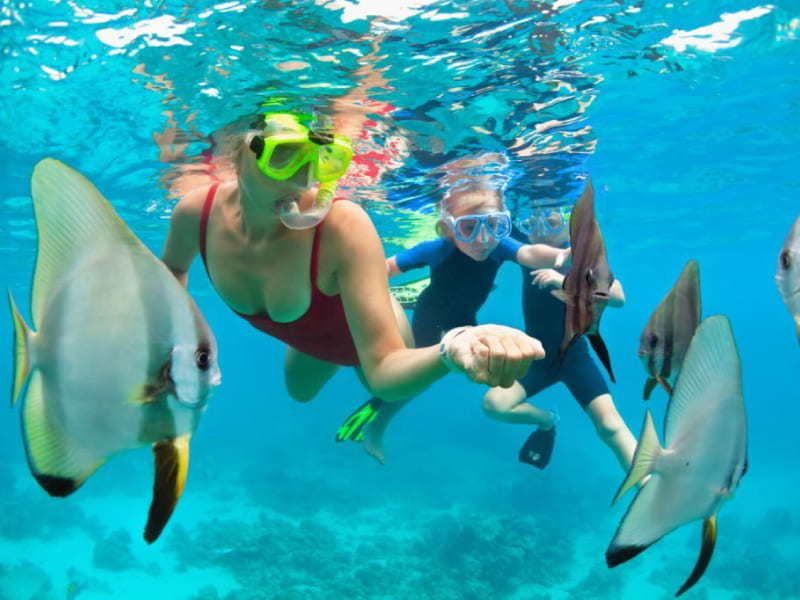
Situated off the east coast of Santa Cruz, North and South Plaza were uplifted from the sea floor and are very old islands, in the neighborhood of 3,000,000 years old. Currently, visitors are forbidden to go ashore on North Plaza, but diving off the backside of North Plaza is a nice, easy and relaxing dive, with relatively little current or surge. The dive usually begins along the center of the north shore, where a boulder slope with a gradual incline falls to a sand bottom at about 24m (80 ft) white- tipped reef sharks, marble and diamond rays, and waving fields of Galapagos garden eels are found in sandy patches throughout this boulder slope. Most of the action takes place in the first 14 m (45 ft).
Marine Life of Plaza Island: There are huge schools of yellowtail surgeonfish yellow tailed mullets and lots of parrotfish in the shallows. You are more likely to see pelagic, including hammerheads and Galápagos sharks, at the eastern end of the islet. This eastern point can be very good, especially in the warm season (January- May in particular) because cross- currents can bring in manta rays, and even snorkelers can enjoy a lengthy swim with these marvelous creatures. Solitary whale sharks occasionally visit in the hot season Whether snorkeling or diving, sea lions become constant “buddies”.
Gordon Rocks
North-east of Santa Cruz island lie the famous Gordon Rocks. Sometimes called ‘The Washing Machine’ it is a popular site where intermediate and advanced divers go due to challenging currents and upwellings. It is these very currents that bring the plankton to the surface attracting large pelagics from across the sea in numbers.
Marine Life of Gordon Rocks: One of the best places to find Hammerhead sharks and the weird and wonderful Oceanic Sunfish (Mola Mola). Also here are Galapagos sharks, white tip reef sharks, lots of giant sea turtles, mobula rays, sting rays, eagle rays, panamic green morays, Galapagos eels, barracudas and various reef fish.
Meals: Breakfast
5th day: Puerto Ayora – ferry . San Cristobal Island: Tijeretas Hill – Carola beach


Breakfast in the hotel. Our guide will pick up us at 06h45 and will take us to the pier of Puerto Ayora in order to take our ferry to San Cristobal Island. We will travel by speed boat for approximately two hours. Once in San Cristobal Island, another guide welcomes us and takes us to our hotel.
After lunch we will take an excursion to the Tijeretas Hill. This is also known as Frigatebird Hill, is a lookout point with views of Kicker Rock to the west and Shipwreck Bay to the south. From the center of Puerto Baquerizo Moreno, it takes about 45 minutes to reach the top of the hill, which serves as a nesting spot for two species of Frigatebirds. At the base of Tijeretas Hill, there is a small cove perfect for swimming and snorkeling and where is usual to see sea lions and tropical fish. Here we can also appreciate a sea bird such blue-footed boobies and pelican among others. The walk ends at Punta Carola beach where we can see sea lions and sea turtles.
Meals: None
6th Day: Dive to Kicker Rock
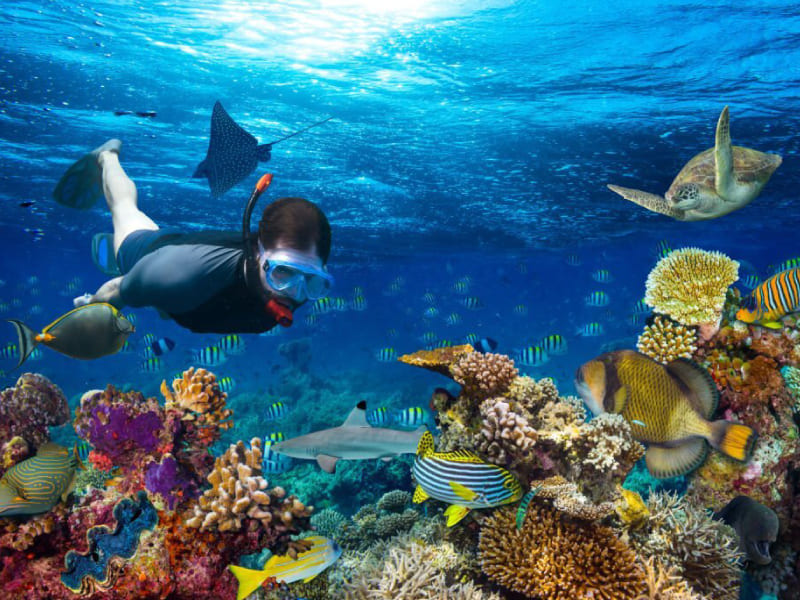


Leon Dormido or Kicker Rock is a rock formation located on the coast of San Cristobal Island in the Galápagos Archipelago. It is a magnificent islet in the middle of the sea, rising 500 feet from the ocean; it has the shape of a giant sleeping lion, hence its Spanish name. The rocks are remnants of a vertical tufa formation and is a place loved by various species of seabirds, sharks, fishes, turtles, sea lions, eagle rays, etc.
For the two dives, we will descend and ascend using the Kicker Rock wall as a reference since there are no buoys or lines that can be used.
At Kicker Rock it is possible to observe white tip sharks, black tip sharks, Galápagos sharks, eagle rays, sea turtles, sea lions, various fishes and, in good weather conditions, hammerhead sharks.
After the dives, we will go to a beach called Manglesito (time from Kicker Rock is 30 minutes). We will have lunch on the boat (according to a National Park law, no food is allowed on the beach) and then we will enjoy the beach for approximately 1.5 hours. During that time, you can also snorkel around the bay.
Meals: None
7th day: San Cristobal – flight – Quito
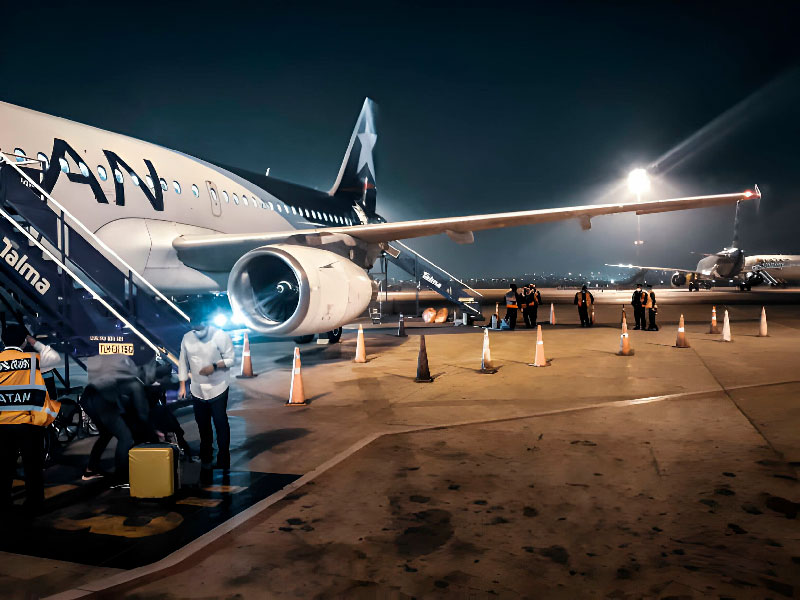

Our guide will pick us up from our hotel and drive to the airport in order to take our flight to Mainland
Meals: None
